Army.ca's Fallen Comrades

They shall grow not old, as we that are left grow old


The Canadian Airborne Regiment

(Disbanded)
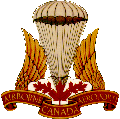

Armorial Description

An open parachute between two vertical wings with shroud lines issuant from a cloud resting between the bases of the wings. At the junction of the shroud lines and superimposed on the cloud, a single large maple leaf flanked by two smaller maple leaves on each side; the whole resting upon a riband scroll inscribed, AIRBORNE - CANADA - AEROPORTE. Wings of scroll in gold coloured finish. Parachute, clouds and maple leaves in silver colour finish.


Official Abbreviation: CAR

Motto: Ex Coelis (From the clouds)


Battle Honours (12)

Second World War

    NORMANDY LANDING
    MONTE MAJO
    DIVES CROSSING
    ANZIO
    THE RHINE
    ROME
    ADVANCE TO THE TIBER
    MONTE CAMINO
    MONTE LA DIFFENSA - MONTE LA REMETANEA
    SOUTHERN FRANCE
    North-West Europe, 1944-45
    Ardennes

Order of Precedence: N/A
Go back to the Infantry Regiments page.
Go back to the Army home page.
Military Word Of The Day
DG
:
director general


» Download the iPhone/iPad Military Terms app! «


Today in Military History

February 24


1303:

Battle of Roslin Glen, Scottish victory in the bloodiest battle ever fought in Scotland.


1838:

Battle of Fighting Island. A force of 2,000 Canadian Militia and British regulars cross the frozen Detroit River in order to dislodge 150 ill-equipped republicans of William Lyon Mackenie's "Patriot Army of the North-West". After a brief exchange of fire, the rebels flee over the ice to the American side of the border.


1900:

In South Africa, Sergeant Firth of the Duke of Wellington's Regiment twice braved enemy fire to rescue wounded men. He was badly wounded in the face on the second occasion. Elsewhere, near Colenso, Lieutenant Inkson of the Royal Army Medical Corps also rescued a wounded man, carrying a maimed fellow officer to safety for some 400 yards through heavy fire. Inkson and Firth each received the Victoria Cross.


1901:

Corporal Clements of Rimington's Guides suffered a bullet in the lungs during a skirmish with Boers. Lying alone, the Boers called on him to surrender, but he instead chose to fight on, and killed three of his opponents at close range. The others promptly chose to surrender to him instead. Clements survived his wound and received the Victoria Cross.


1915:

Armentières France - Canadian Corps takes over 6.5 km section of trench line near Armentières.


1917:

Washington DC - German plan to get Mexican help in WW I exposed by US Naval intelligence; Zimmerman telegram


1940:

Germans revise plan for attack to West to include panzer assault through Ardennes


1944:

Bomber Command attacked Schweinfurt, the main German industrial centre for ball-bearing production, perceived as a bottle-neck industry which could seriously affect armaments production. 734 aircraft took part, following a USAAF raid the previous day. The RAF tried a new tactic, dispatching the force in two waves separated by two hours, in the hope that the Germans would exhaust their night-fighters against the first wave, leaving a clear run for the second. This apparently worked, since of the 33 aircraft lost, only four from the second wave were thought to have fallen to fighter attack. The bombing, however, proved relatively ineffective, with many aircraft dropping short.


1944:

HMCS WASKESIU picks upa Submarine in the early morning. After 2 hours of depth charging, the contact was lost. At 0530, she regains the contact and blankets the U-Boat with everything from 4" HE shells to 20 mm Oerlikon and Bren Gun Fire. As the da


1965:

Operation Rolling Thunder, sustained American bombing of North Vietnam, begins


1991:

Canada's "Desert Cats" fighter squadron, stationed in Qatar, makes its first ground attack sorties against Iraqi targets


1991:

Iraq - Saddam Hussein refuses Allied ultimatum to leave Kuwait; US and Allies begin ground war assault on Iraqi troops


» Download the iPhone/iPad Military History app! «


Advertising